Published by Kiddopia Team

 Ages 2–7 · Educational · Learning
Published by Kiddopia Team
Ages 2–7 · Educational · Learning
Ages 2–7 · Educational · Learning
Published by Kiddopia Team
Ages 2–7 · Educational · Learning
Ask a preschooler what shape a slice of pizza is, and you'll hear "triangle" with total confidence. Ask about the whole pizza, and you might get "dinner." Fair enough. Either way, your child is already paying attention to shapes, even before they know all the names.
Long before counting to twenty or adding apples, kids sort the world by how things look. Round things go with round things. Pointy things go somewhere else. That is why shapes matter so much for preschoolers. For most kids, this is their first real math.
Babies study faces, and faces are mostly circles and ovals. Toddlers learn that the round block fits the round hole, usually after trying the square one a few times first. By preschool, kids are ready to learn names for the shapes they've been noticing for years.
A number like "three" is hard to hold onto because you can't pick it up, while a triangle is something your child can hold, run a finger along, and count the corners of. Having something solid to work with makes math easier to grasp, so learning shapes for preschoolers tends to come before most other early math.
Shapes build more early math skills for preschoolers than most parents expect. Comparing a big circle with a small one is early measurement. Putting blocks into piles is sorting. Noticing that a square has four sides and a triangle has three is counting with a reason behind it.
Shapes help with spatial reasoning too, which is how we picture things fitting together or moving around. Kids use it later for puzzles, building, maps, and sports. Letters are made from shapes as well. A child who spots circles easily will find the letter "O" much less mysterious, and knowing lines and curves helps when it's time to write their name.
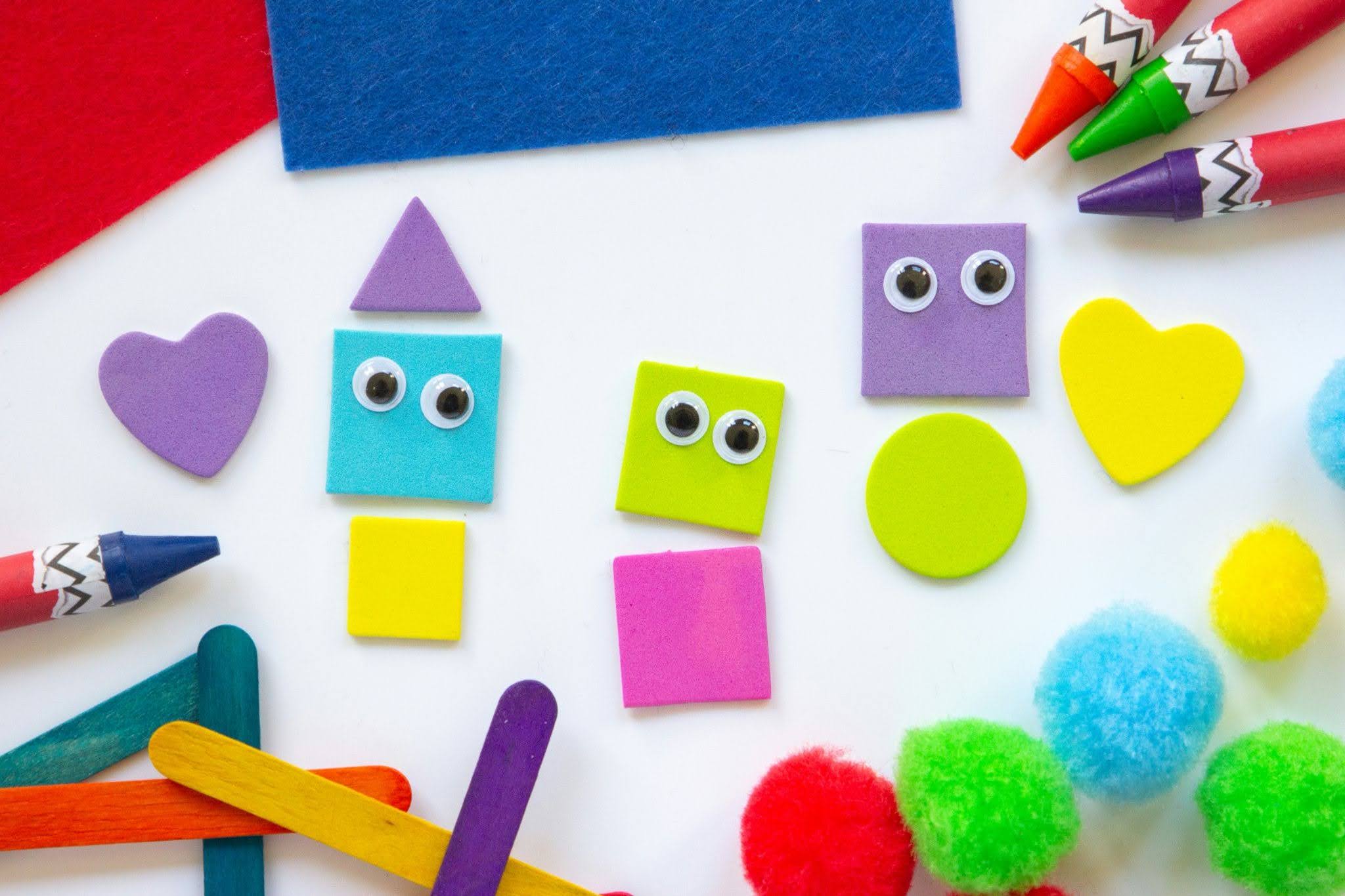
The four basic shapes for preschoolers are the circle, square, triangle, and rectangle. You'll find them on clocks, windows, sandwiches, and doors. When your child knows those, move on to ovals, stars, hearts, and diamonds. Hearts usually go over well.
Older preschoolers can try 3D shapes. A ball is a sphere and a block is a cube. An ice cream cone is, of course, a cone. "Cylinder" is a very satisfying word for a four-year-old to say, so expect to hear it at dinner, in the car, and possibly at the dentist.
Shape recognition for preschoolers grows when kids start noticing what each shape is made of. Talk about sides, corners, and curves with your child, and before long they'll be explaining why the window is a square, whether or not you asked.
You can figure out how to teach shapes to preschoolers without a single worksheet. Go on a shape hunt around the house or down the street. The clock is a circle, the door is a rectangle, and the roof on the house across the road might be a triangle. Some kids get very competitive about this.
Meals help too. Cut sandwiches into triangles or squares, arrange crackers in patterns, or give a pizza pepperoni eyes. You can tape a big shape onto the floor with painter's tape and let your child hop along it or drive toy cars around the edges. Playdough, cookie cutters, shape sorters, and blocks all turn shapes for preschoolers into things kids can touch and build with.
Screen time can reinforce shapes for preschoolers as well, if it's the right kind. In Kiddopia, Math Whiz takes kids to a sunny beach to practice shapes and patterns, along with counting and early addition & subtraction. It has more than 40 learning modules, so there's plenty to work through, and the beach buckets and sun hats keep it cheerful.
Our puzzle game, Buzzle, helps in a different way. Kids match each puzzle piece to its silhouette, which means looking closely at edges, curves, and outlines. Finish a puzzle, and a nursery rhyme like “Humpty Dumpty” or “Jack and Jill” comes to life in song.
The signs are usually small. Your child might say the stop sign has "lots of sides," call a slice of cheese a square, or point out the rectangle block in their tower. Moments like these show that shapes for preschoolers are sinking in, and your child is starting to look at things the way a mathematician would.
So the next time your preschooler refers to a pizza as "dinner", agree with them. Then mention the circle shape it came in and the triangles on their plate.


Works for both iOS & Android
via smart one-link redirect